You have broken away from the planetary brain!

Showing posts with label TOL Babes. Show all posts

Friday, January 9, 2015

Episode Spotlight: "The Premonition" (1/09/1965)


“The Premonition”
Season 2, Episode 16 (48 overall)
Originally aired 1/09/1965


Fifty years ago tonight, The Outer Limits was facing cancellation. It's probably appropriate that this, its penultimate offering, would dwell on the nature of time.... since the show's time was just about up.


Ace Air Force pilot Jim Darcy is in the cockpit of an experimental X-15, testing the limits of speed and maneuverability. He reaches Mach Six and breaks not the only the sound barrier but the time barrier, the resultant shock wave of which forces him into a  crash-landing. Once on the ground, he’s shocked to discover that everything appears to be frozen--- not “frozen” in the ice-encrusted kid-friendly Disney sense, but “frozen” as in rock-solid and immovable… people included.


He’s also shocked to discover his wife, Linda, who has wrecked her car near the crash site. She isn’t frozen in time, which leads him to speculate that she was caught in the shock wave and carried along with him to… where, exactly? They return to Jim’s base, where everything and everyone is frozen… including their daughter, Janie, who they find right in the path of a delivery truck, which is rolling straight toward her thanks to an errant driver who forgot to engage the parking brake.


Comparing the X-15’s chronometer against the one in the base’s control room, Jim deduces that the couple were displaced in time and thrust several seconds into the future. Time isn’t actually frozen---- it’s just moving extremely slowly, and will eventually catch up with them. They encounter an iridescent man (the “Limbo Being”) who explains that he, like them, was once displaced in time; however, because he missed the moment of time's re-synchronization, he is eternally trapped in nothingness. The Darcys must be in their respective places--- Jim in the X-15’s cockpit, Linda in her car--- at the precise moment time corrects itself or they’ll face a similar fate.


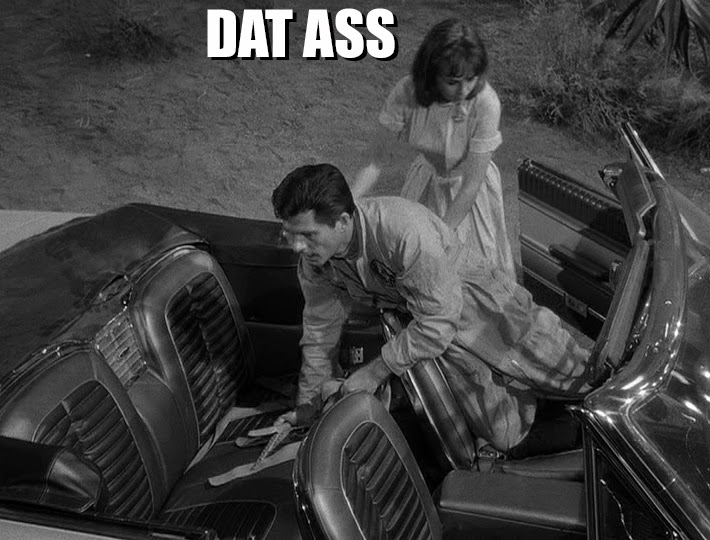
Finally! That MacGyver prequel everyone's been clamoring for.
This unfortunately means that neither of them will be anywhere near Janie to prevent what will almost certainly be a fatal accident. Jim cuts the seat-belts out of Linda’s car (which, like his downed X-15, isn’t frozen in time) and rigs a makeshift emergency brake of sorts that will hopefully, when time resumes its normal pace, stop the truck and save Janie. They assume their places just as time catches up with them.


Jim ditches the X-15 into the sand, and Linda crashes into the boulder. Both are unhurt but have no memory of their experience. An intangible feeling--- a “premonition”--- sends them rushing back to the base, where they find Janie unharmed.


.
RANDOMONIUM

“The Premonition” began as “Gordian Knot,” a story treatment by Ib Melchior, who wrote “Water Tank Rescue” and “Voice of Infinity” for TV’s Men into Space, plus the screenplays for 1959’s The Angry Red Planet (which he also directed)  and 1964’s Robinson Crusoe on Mars (a film directed by Outer Limits six-timer Byron Haskin). Said treatment was expanded into teleplay form by Samuel Roeca, who would go on to write several episodes of Mission: Impossible and serve as story editor on the third and final season of Land of the Lost (which was an awesome show if you were a kid when it originally aired, which I was… those Sleestaks were fucking cool).


Gerd Oswald, who helmed more Outer Limits episodes than anyone else (a whopping fourteen), is back for one more ride in the director’s saddle. I wish I could say his final offering was on par with his earlier brilliance… but it most certainly isn’t. There’s really not much here: lots of Air Force stock footage, lots of running around, and a lot of freeze frames depicting frozen time… nothing impressive. However, I do like the scene with the Darcys walking through the control room, weaving in and out of frozen folks (which are actually actors standing still; there's a really nice overhead shot of this tableau in act three), so I guess that’s a good staging effort. The crashed X-15 mockup looks good, but that’s more of a set design success than a directorial one. There’s definitely some production value added by shooting on location at a real Air Force base at Paramount Studios, which looks enough like a military base to fool your average TV-watching idiot (like me; thanks as always to David J. Schow for correcting me), and Director of Photography Kenneth Peach captures it all ably with minimal flourish… except for some extreme close-ups of William Bramley’s mouth during the countdown, which is a bit off-putting.


.
It feels like a good five or ten minutes of screen time is used up just showing the Darcys running back and forth repeatedly from the crash site to the base and back again. It doesn’t help that the same few camera angles are used each time (I assume all these sequences were shot together, so Dewey Martin and Mary Murphy--- or maybe their stunt doubles--- must’ve been hot, tired and a bit pissed by the end of the day). Since I have so much time on my hands (ha! Get it?), I threw together a super cut of all the repetitive shots for your amusement (or irritation):


Okay, so it wasn’t quite five or ten minutes. Sure seems like it, though. Y’now, Linda’s car didn’t look totaled by any means. Shouldn't they have at least tried to start it before spending all that time and energy running back and forth? And how far is it from the crash site to the base? I’m assuming it’s at least a couple miles.


“The Premonition” feels a lot like one of the hour-long fourth season Twilight Zone episodes due to the glaring amount of padding and repetitiveness. It never quite gets boring, but it never really moves at a sufficiently brisk pace, either. Unfortunately, the long silences gave me a chance to start mulling things over and picking things apart. If time is frozen, or at least moving in extreme slow motion, how are the Darcys able to breathe? Wouldn't the air be solid as well? Nothing can be moved in this rigid, motionless environment, so I guess it’s lucky for the Darcys that virtually every door on the base was left wide open so that they can go wherever they please (which seems pretty unlikely for a military installation). And how the hell did that lady ever get the babysitting job? She leaves the kids alone and unsupervised immediately after Linda drops Janie off with her, which directly leads to Janie’s dire predicament. And then... hoo boy... there’s that Limbo Being fucker.

The Limbo Being is, hands down, the single stupidest “creature” in the entire series run. It’s not even monstrous… it’s just a guy painted silver behind a blur filter (at least that’s what it looks like; I have no idea how the so-called “effect” was actually achieved). He has some kind of weird aura around him that separates him from the rest of the limbo environment.... too much, actually. We never see him interact with the Darcys, which makes me wonder what a shot would look like with all three of them in it... is the aura just some kind of cloud that follows him around? He’s wearing a snazzy blazer, so at least he looks presentable. And for some unfathomable reason that has no bearing on anything, he shares Frankenstein’s Monster’s deathly fear of fire.  Why? I couldn’t tell you.

I get that he’s a “prisoner in time,” and that he got that way through similar circumstances (Darcy’s X-15 is presumably the fastest plane ever built, so I’m not sure how this sad sumbitch ever managed to go that fast, but whatever), but that doesn’t explain why he’s at the Air Force base at the exact time that the Darcys have their time-out-of-whack experience. Did his time barrier violation event happen there too? Or or did he walk there from… I dunno, wherever? I guess it’s possible that existing outside of normal time has some spatial advantages (instantaneous teleportation, maybe), but the fact that he can’t get past a fucking flare or pass through solid walls suggests otherwise (however, since every door on the base is open, I guess he could just exit the building another way, right?). And he’s clearly articulate, so why does he make those creepy boogeyman sounds when he first appears? He’s a clumsy, ill-conceived convenience, placed in the Darcys’ path for the sole purpose of telling them (and us) exactly what is happening and how they can escape (which seems counterproductive, since being so open with them dramatically reduces his odds of horning in on their escape to facilitate his own), but his presence only serves to detract from the story. He does, however, give a damn-near poetic (and admittedly well-delivered) summation of his wretched existence:

LIMBO BEING:
If you miss your chance to return, one-millionth
of a second behind time, time will pass you by, and
leave you where I am now, in forever now. Black, motionless
void. No light, no sun, no stars, no time. Eternal nothing.
No hunger, no thirst. Only endless existence.
And the worst of it? You can’t die!


Speaking of The Twilight Zone, they tackled the “frozen time” idea with “A Kind of a Stopwatch (right),” a pretty dismal entry starring the normally-delightful Richard Erdman as an obnoxious dweeb who ends up with a magical stopwatch that… well, you know. Rod Serling and Company also gave us “Elegy” and “Still Valley,” neither of which deal expressly with frozen time, but do feature large groups of frozen people. The 80’s revival series (unofficially known as The New Twilight Zone) mined the idea twice: “A Little Peace and Quiet (below left)” is essentially a pointless remake of the aforementioned “A Kind of a Stopwatch,” while the clever “A Matter of Minutes (below right)” depicts a couple getting stuck in a limbo state between two moments in time and witnessing crews of workers constructing the minute to follow.


.
Check this out: after Jim climbs out of his X-15, he doesn’t notice Linda’s crashed car nearby until he hears her moaning behind the wheel. But here’s the thing: her car is directly in his line of sight two or three times before this moment. The most obvious example can be found at time stamp 11:41, which is supposed to be Jim reacting to the sight of the frozen coyote chasing the jackrabbit, but if you pay attention to the angles and spatial geometry and whatnot, he's actually looking directly at her at this moment, which becomes apparent once you see where exactly her car is. Nitpicking? Yeah, maybe a little. This is what y'all pay me for.


.
As much as I like Dewey Martin, his Jim Darcy comes off as a bit of a dick when you examine his interactions with his family. After he rigs the seat-belts in the runaway truck, he takes a quick look at his daughter and says, simply and emotionlessly, “All we have now is hope.” A few minutes later, when Linda gives him a last “I love you” before time catches up with them, he doesn’t bother to return the sentiment. After time re-synchronizes and he climbs out of his wrecked X-15, he makes sure somebody puts the fire out before he even bothers to see if Linda survived her car crash. And, most egregiously, he provides The Outer Limits with its first and only count of spousal battery when he “takes charge” of Linda’s hysteria by straight up smacking her across the face (talk about putting the "palm" in "Palmville"). There are a few women throughout the series' run that had it coming (I'm looking at you, Vera Finley), but I think Linda's reaction is perfectly acceptable (I'm pretty sure all of us--- male or female--- would lose our shit if everything stopped moving). And don't forget that, just moments before, she was in a car accident and hit her head... so she may very well have a minor concussion. Macho prick.

Being Top Gun means you can look directly into the camera without doing a retake.

I love the subtle homo-eroticism on display during Jim’s test flight. The pilot flying behind him jovially remarks that he's “looking real good from back here,” to which Jim replies, “I'm glad you're enjoying the view.” I can just picture these two engaging in some spirited grab-ass in the locker room, and I’m pretty sure this brief exchange inspired 1986's Top Gun, a film positively drenched in sweat, hair gel and ironic machismo.


.
AURAL PLEASURE

“The Premonition,” like all second season efforts, is scored by Harry Lubin, drawing from his vast library of pre-recorded music (much of it came from his previous stint on One Step Beyond). This week’s assortment includes a few of the more familiar pieces we’ve been enjoying all season, among them: "Dark and Scary," "Dreamy Lullaby," "Haunted Mansion," "Hidey Hole," "Footsteps of the Killer 1" and "Destitute."

“Hidey Hole” is a quick little vibe flourish which, while initially effective for reinforcing the strangeness of the frozen people the Darcys encounter, quickly becomes tiresome because it’s used, oh I dunno, about fifty or so times throughout the episode. I considered watching it again for the express purpose of getting an exact count, but I came to my senses just in time (ha! See what I did there?).

.
DRAMATIS PERSONAE

I know Dewey Martin (Jim Darcy) from his portrayal of a thirsty--- and murderous--- astronaut in the Twilight Zone episode “I Shot an Arrow into the Air.” Genre fans may remember him as Crew Chief Bob in 1951’s The Thing from Another World, or as Mike Apollo (fitting name, given his other genre work) in "Leona" on Mission: Impossible. He also enjoys a coveted Robert Culp connection thanks to his appearance on I Spy (“One of Our Bombs Is Missing”).


.
Mary Murphy (Linda Darcy) shares in the Robert Culp connection glory, as she too appeared on I Spy (“Any Place I Hang Myself Is Home”). Other notable genre roles include stints on The Fugitive (“Nicest Fella You’d Ever Want to Meet”), Alfred Hitchcock Presents (“A Secret Life”) and Circle of Fear (“Creatures of the Canyon”). She also appeared in the 1951 George Pal film When Worlds Collide, the cast of which also included Peter Hansen from last week’s “The Brain of Colonel Barham. TOL Babe? Most definitely. Yum.


.
Other than The Twilight Zone, William Bramley (“Baldy” Baldwin) hits all our usual genre connections. He appeared on Star Trek (“Bread and Circuses”), The Fugitive (“The 2130” and “A Clean and Quiet Town”), The Invaders (“Nightmare”), Alfred Hitchcock Presents (“The Test”), and The Alfred Hitchcock Hour (“The Tender Poisoner” and “Return of Verge Likens”).


.
Kay Kuter (the unfortunate Limbo Being) has lots of genre television credits outside of The Outer Limits, but they didn’t occur until the late 80’s and beyond. You’ll find him in episodes of Star Trek: The Next Generation (“The Nth Degree”), Star Trek: Deep Space Nine (“The Storyteller”), the 80’s Twilight Zone revival series (“Grace Note”), V: The Series (“The Overlord”), The X-files (“The Calusari”), and the short-lived Brimstone (“Mourning After”). On the big screen, he enjoyed an uncredited bit part as a priest in 1956’s The Mole People and, later, appeared in 1984’s The Last Starfighter and 1989’s Warlock.


.

Li’l Emma Tyson (Janie Darcy) only has one other genre credit of note: she appeared in “The Trap” on The Alfred Hitchcock Hour. (however, because the series isn't available in even semi-decent quality, I'm using a Green Acres screen cap below... and before you get bitchy, let me just point out that the star of Green Acres, Eddie Albert, also starred in "Cry of Silence" earlier this season; so it's at least an approximate connection). Dorothy Green, here credited as “Matron” (which we’d call a child care provider today), also appeared on Boris Karloff’s Thriller (“Rose’s Last Summer”) and the pilot movie that launched The Six Million Dollar Man. On the big screen, she can be found in the 1954 Giant-Ants-on-the-Rampage opus Them!, the noir classic The Big Heat (1953) and the decidedly non-classic Help Me… I’m Possessed (1976). Finally, Christopher Riordan (Frozen Soldier) is the only TOL vet in the cast this week (he played “Young Doctor” in season one’s “The Chameleon,” plus he’ll back next week as “Young Scientist”). Three Outer Limits episodes is impressive, but he topped that number on The Fugitive with a total of four: “Man in a Chariot,” “Ballad for a Ghost,” “Brass Ring” and “The Old Man Picked a Lemon.” Two years later, he’d play another Young Scientist on the big screen in 1966’s Fantastic Voyage.


.
HOME VIDEO RELEASES


MGM’s home video releases of Outer Limits episodes initially followed the series’ production order… for the first three episodes. After that, they pulled at random from both seasons (though they did focus on the more familiar, generally superior episodes early on). When they dumped the final dozen episodes onto the market in 1991, the red-headed stepchildren that comprised the latter half of the second season--- a group which includes “The Premonition”--- finally saw the light of day.

The VHS series in its entirety is a beautiful collection, and most of the covers therein quite adeptly capture the spirit of their respective episodes quite well (and are gorgeous to behold). And then there's this boring "effort," which probably took all of five minutes to throw together. Yawn. Jim looks like he's falling asleep there... which, now that I think about it, is probably totally appropriate for the episode. Ahem.Here are the two shots from the episode used:


In Columbia House’s mail-order exclusive Collector’s Edition series, the episode was paired with next week’s “The Probe.”


“The Premonition” was not among the lucky 28 episodes chosen for LaserDisc release; however, it was present and accounted for when the series hit DVD in 2002 (season one) and 2003 (season two). I guess this isn’t really a special honor, since all 49 were right there with it. Anyhoo--- in 2007, MGM released the series again, this time splitting it up into three volumes (two for season one, one for the abbreviated season two). In 2008, they bundled those three volumes together for a so-called “45th Anniversary Collection.” In a diabolical act of contempt for their customer base--- or extreme laziness--- they used the identical discs from the original ’02 and ’03 releases, which means no matter which ones you buy, you’re gonna get the same shitty DVD-18s (double-sided discs) that nobody uses anymore because they’re delicate and prone to failure. The same DVD-18s were foisted upon the Australian market as well, but at least the folks down under were treated to some neat packaging variations (thanks to David J. Schow for these).


 Across the pond in the UK, MGM released season sets basically identical to the original US sets… except that they used single-sided discs. This injustice continues to boil my blood and steam my clam (don’t ask).


I assume most of you already own the DVDs, but if you don’t… well, I can’t really recommend that you buy them at this point, unless you can get them really cheap (and even then I would avoid used copies like the plague, given the tendency of DVD-18s to fail over time). If you’re a Hulu Plus subscriber (at $7.99 a month, why wouldn’t you be?), you’re already covered: as of two weeks ago, the entire series is available for PC, TV and mobile streaming.

.
MERCHANDISE SPOTLIGHT

Dimensional Designs has created high-quality model kits of nearly every Outer Limits monster and alien imaginable… but there are a few omissions. The Limbo Being is one, but you might get a different impression if you visit their website: they have a listing for a Limbo Being (actually, their name for him is "Limbo Man"; DD/OL/LM-41), sculpted by Sean Samson and Danny Soracco in the usual 1/8-scale size… however, there’s no picture of it, no box art, and no option for ordering. It was clearly planned at some point, but does it exist? I couldn’t tell you. Should it exist? Probably not.

.
THE WRAP-UP
“The Premonition” is ultimately frustrating because there’s a great idea at its center, but it’s muted considerably by a muddy, repetitive narrative and an underwhelming, superfluous supernatural being. It’s certainly not terrible, but it’s nothing close to what it could have--- should have--- been. But The Outer Limits was limping toward its network-imposed finish line at this point, so I suppose it’s a minor miracle that it turned out as good as it did.


Woah, I just thought of something: what if the spacious, ponderous narrative is in fact intentionally slow and repetitive, a Christopher Nolan-esque construct designed to convey the desolate emptiness of timelessness? If so, this just might be smartest, most subversive offering of the Brady regime. Okay, probably not. But what if…?

Friday, January 2, 2015

Episode Spotlight: "The Brain of Colonel Barham" (1/02/1965)


“The Brain of Colonel Barham”
Season 2, Episode 15 (47 overall)
Originally aired 1/02/1965


“Man or machine. You can’t have it both ways!”


Brilliant but arrogant astronaut Colonel Alec Barham is the ideal candidate for the first manned space flight to Mars; unfortunately, he contracts and is grounded by a terminal illness. His superiors--- General Pettit and Doctors Rahm and Hausner--- devise a plan in which they’ll extract his brain and create a cybernetic hybrid that will have the resilience of a machine but the quick, organic thinking of a human being, which will be sent to Mars and secure the United States’ lead in the Space Race. After his initial shock at the idea, Barham agrees.

His wife, Jennifer, opposes the idea, much to his callous amusement. Theirs is a loveless marriage, but she’s stayed with him because of her strong aversion to the idea of divorce…. much to the chagrin of Major Douglas McKinnon, the psychologist assigned to monitor Barham’s mental and emotional state, who has fallen in love with her. The operation goes off without a hitch, and soon Barham’s mental capabilities grow beyond the project leaders’ wildest dreams. They seem all-too-willing to look the other way when his ego grows proportionally and he develops a god complex, paying no mind to McKinnon’s dire warnings.


One of Barham’s new talents is the ability to emit an energy bolt that temporarily neutralizes free will. Angry that Jennifer refuses to visit him in his new mechanized state, Barham forces Ed Nichols (the technician assigned to maintain his complex systems) to attack her. McKinnon manages to intervene before she is hurt; however, his actions spur Barham into sending Dr. Rahm after him with a pistol.

McKinnon narrowly avoids getting blown away and pleads with General Pettit to terminate Barham. After Barham tells Pettit that he no longer recognizes his authority and that he’s assuming control of the project, Pettit agrees to pull the plug. Barham responds by holding Jennifer and McKinnon hostage, prompting Pettit to take the megalomaniac brain out from outside the window with a sniper rifle.


.
RANDOMONIUM


“The Brain of Colonel Barham” reunites writer Robert C. Dennis (here revising an original teleplay by Sidney Ellis) and director Charles Haas, who previously collaborated on “Cry of Silence” back in October (Dennis also scripted “’I, Robot’” and “The Duplicate Man”; Haas also directed “Cold Hands,Warm Heart” and “Keeper of the Purple Twilight”). Capturing the proceedings on celluloid is Director of Photography Kenneth Peach. The script isn’t necessarily terrible, but it’s certainly nothing special, even looking past the hoary brain-in-a-jar cliché that had been worn into the ground two decades earlier with Universal’s Frankenstein franchise. There are a few snappy snatches of dialogue, mostly from the shockingly mean-spirited Barham (Jeez, who pissed in this guy’s Astronaut-Os?), but my favorite line comes from General Pettit, during his initial briefing with Barham:

BARHAM (snidely):
Tell me something, General:
how would I do with pretty girls?

PETTIT (glancing at Barham’s wheelchair):
How are you doing now?

Oh, snap. Burn! I wish the script had more zingers like this; unfortunately, Barham goes along merrily insulting and degrading those around him and receives little to no pushback. Jennifer gets the bulk of his heartless wrath, which is doubly insulting considering the fact that, before he fell ill, he was rampantly cheating on her (and actually has the audacity to flippantly remark that she “took their wedding vows much more seriously” than he ever did). The guy is a supreme dick, and it’s a shame that he never receives an appropriate level of comeuppance--- he gets a quick death without any real suffering, which is unfair in the extreme. Imagine what The Twilight Zone might have done with him… and speaking of which, his line “Why me? Why do I have to die, with the world full of useless slobs?” sounds like it was ripped from Rod Serling’s “Escape Clause,” in which egocentric hypochondriac David Wayne angrily wonders “Why does a man have to die? The world goes on for millions of years, and how much a man’s life? This much, a drop!” Serling’s sentiment is more powerful and evocative to be sure, but then, Dennis is no Serling. I do think it would’ve been more effective to have Jennifer somehow be the one who ultimately takes Barham out… yeah, that would’ve been some Twilight Zone–style cosmic justice right there.

There’s nothing visually compelling going on here; even the sprawling computerized array keeping Barham’s brain alive (which resides in the center, inside the requisite glass bell jar with a light bulb inside for effect) isn’t very interesting to look at. This is science fiction, dammit! This is a textbook example of a missed opportunity to create something truly unique and special… which would elevate this episode considerably, the same way beautifully-conceived aliens and monsters improved otherwise half-baked efforts like “Cold Hands, Warm Heart” and “Keeper of the Purple Twilight” (both of which were directed by Haas, interestingly enough). An early night scene in Barham’s hospital room, in which he verbally spars with an ill-prepared McKinnon, is the only thing approaching mood and atmosphere; otherwise, the look of the episode is bright, bland and utterly forgettable.


The Brain Center at Barham's.
Speaking of the Cybernetic Brain Center™, I’m unclear why Barham’s brain wasn’t put into a robot body instead. Barham’s brain will eventually pilot a spaceship to Mars; it seems like a no-brainer (ha!) that he’d be housed in something ambulatory so that, when he lands, he can actually, y’now, GET OUT OF THE FUCKING SHIP. Otherwise, what’s the point of going all the way to Mars in the first place? However, that might’ve resulted in the reuse of the pathetic Adam Link costume from “’I, Robot’,” so I should probably just shut up and be grateful. I love Wesley Addy, but his portrayal of Rahm is downright creepy, due mostly to his slow, laconic delivery (which would probably be hypnotic if he had a long stretch of dialogue, which Dennis never gives him). And I’m pretty sure Hausner is one of the Nazi scientists brought to the US thanks to Operation Paperclip… it’s not hard to imagine the Nazis working on this kind of thing. It's probably worth mentioning that the actor playing Hausner, Martin Koslek, played Joseph Goebbels (Hitler's propaganda minister), as well as other Nazi soldiers, multiple times throughout his long career.

Oh hell, I just thought of a way better ending for this episode.  Barham is starting to lose his grip, flinging lightning around the room while terrorizing Jennifer and McKinnon. Hausner and Rahm burst into the room and demand that he stop his foolish tantrum immediately or he’ll jeopardize everything---- “everything” being an insidious Neo-Nazi plot to take over the world, a project that began in Nazi Germany and simmered for years and is now coming to fruition on American soil. Barham realizes that he’s been a pawn all along and apologizes to Jennifer, then destroys himself and takes Hausner and Rahm with him. It’s certainly a different direction, but you could pepper a couple of bits earlier on that cast Hausner and Rahm in a questionable light. Hey, you can’t deny that this would imbibe the episode with a healthy dose of dramatic heft, not to mention an emotional arc for Barham and Jennifer (and McKinnon by association). It could be season two’s “The Hundred Days of the Dragon” equivalent.

And speaking of hypnotic, what the hell is up with Robo-Barham™ trying to seduce McKinnon into confiding in him? Here’s the dialogue:

BARHAM:
Problems, Major? They’re only for mortals.
Would you like to discuss yours? I could
help you now. Why don’t you tell me all about it?
It’s really nothing to be ashamed of. Just
start talking. It’ll make you feel much… better.

Yes, he’s only a brain in a jar, but he’s pretty obviously trying to get into McKinnon’s pants despite his utter lack of equipment. No wonder he’s so mean to Jennifer… she could never give him what he really wanted. Perhaps his hostile demeanor, at the end of it all, is merely symptomatic of a lifelong suppression of his true sexual identity. Also note McKinnon’s disgust when he shakes off Barham’s advances… he’s either really homophobic or suffering in a similar state of denial. Of course, this all implies a level of character (and thematic) depth that, sadly, this episode couldn’t possibly achieve. So the point of this entire scene is anybody’s guess.

It’s undeniably fun to watch McKinnon’s Voice of Reason stance constantly disregarded or outright ignored by the project leaders. It does beg the question, however: why did they assign a psychologist to profile Barham at all? McKinnon turns in a comprehensive report advising against using Barham for the project, accurately predicting exactly what will ultimately happen, and his only response from Pettit is that it “didn’t make (him) sleep any better.” It’s also amusing that Pettit only sees reason--- finally--- when Barham openly defies his authority, not when, y’now, people are getting assaulted and shot at and whatnot.

Soon before the final showdown, Brainham™ demands that his glass jar be replaced with something larger and more protective. I have to seriously question his “godlike” nature and “superior” intellect when, despite possessing the ability to control energy and fling it around at will, he never thinks to simply project an energy field around his jar. D’oh!

As in “Counterweight” last week, we get a completely superfluous shot of a rocket in outer space, even though there’s never a space flight in the episode. This rocket is very similar to the needle-nosed craft--- the XMP-13 from the 1959 TV series Men into Space--- seen multiple times in season one (“The Man Who Was Never Born,” “Nightmare” and “The Children of Spider County”), but it’s not quite the same rocket: the nose is rounder and lacks the needle, plus the fins are a slightly different configuration. There’s no way the show could afford to create a brand new rocket model, complete with flames coming out of its ass… so where did this thing come from? My curiosity was duly piqued, so I embarked on an epic internet search… which lasted all of five minutes.  It occurred to me that The Outer Limits had pilfered Men into Space pretty extensively, and maybe this rocket also originated there… and as it turns out, my hunch was right. I found it in the 9th episode (“Edge of Eternity”), originally broadcast December 2, 1959. And in the 7th episode ("Space Trap"), BOTH rockets appear!


Wow, all 38 episodes of Men into Space are available on YouTube, and I’m only now finding this out? Had I known, I would’ve been pulling comparison shots every time its footage appeared on The Outer Limits. Dammit, all sorts of things are opening up now that I’m almost done here…. first Hulu makes the show available on mobile devices, and now this. What’s next? A fucking Blu-ray announcement?

.
AURAL PLEASURE

“Barham” gets its musical underscore from the library of stock cues from composer Harry Lubin, much of which was recorded from his One Step Beyond days. Most of the pieces heard this week have already appeared in earlier season two episodes; among them are:
Certain Doom
Hostile Galaxy
Drama Chord
Paranormal 1


.
DRAMATIS PERSONAE

Grant Williams (Major Douglas McKinnon) only has one other genre TV credit (“Dead Ringer” on Alcoa Presents: One Step Beyond), but he’s definitely got big-screen sci-fi/horror clout: He starred in a trio of classic Universal pictures, most notably The Incredible Shrinking Man in 1956 (which was followed by The Monolith Monsters in 1957 and The Leech Woman in 1960). He later appeared in less impressive fare like Brain of Blood (1971) and Doomsday Machine (1972).


.
Colonel Alec Barham is played by Anthony Eisley, whose other genre credits include three tours on The Invaders (“Moonshot,” “The Believers,” and “The Ransom”) and B-films like The Wasp Woman (1959), The Navy vs. the Night Monsters (1966), and 1967's Journey to the Center of Time, in which he co-starred with TOL alum Abraham Sofaer.


And of course, I'd be remiss if I didn't mention that both Williams and Eisley were regular cast members on TV's Hawaiian Eye (1959-1963).


.
There’s a lot of variety to be found in the sci-fi/fantasy/horror credits on the resume of Douglas Kennedy (General Daniel Pettit). He appeared three times on Alfred Hitchcock Presents (“Jonathan,” “A Little Sleep” and “An Occurrence at Owl Creek Bridge”), once on Alcoa Presents: One Step Beyond (“Twelve Hours to Live”), and once on Science Fiction Theatre (“Beyond”). On the big screen, you’ll find him in Invaders from Mars (1953), The Land Unknown (1957), The Alligator People (1959) and The Amazing Transparent Man (1960); he also appeared in several film noirs, among them Possessed (1947), Dark Passage (1947), Whiplash (1948), Backfire (1950), and 1954’s Cry Vengeance, which co-starred TOL’s own Skip Homeier.


.

The résumé of Elizabeth Perry (Jennifer Barham) is pretty light when it comes to sci-fi/fantasy/horror, but she did appear on both Mission: Impossible (“The Brothers”) and Voyage to the Bottom of the Sea (“The Death Ship”). Actually, her résumé is pretty light altogether: in the 27 years that she acted professionally, she only racked up 19 credits. I do like her, but I’m not sure if she qualifies as a TOL Babe or not. I guess…. um, kinda. Okay, yeah.

.
Paul Lukather (Technician Ed Nichols) returns for his second Outer Limits jaunt (he appeared briefly in season one’s “Production and Decay of Strange Particles”). Quinn Martin utilized his services in three Fugitives (“Man in a Chariot,” “Echo of a Nightmare” and “Approach with Care”) and one Invaders (“Moonshot,” which also guest-starred the aforementioned Anthony Eisley). Other notable genre credits include stints on Science Fiction Theatre (“The Man Who Didn't Know”), The Man from U.N.C.L.E. (“The Secret Sceptre Affair”) and Mission: Impossible (“The Trial” and the two-part “The Bunker”); on the big screen, he appeared in Dinosaurs! in 1960.

.
As a huge fan of Universal’s classic horror films, I’m delighted to see Martin Kosleck (Doctor Leo Hausner) in the cast this week: he appeared in The Mummy’s Curse (1944), She-Wolf of London (1946) and the Rondo Hatton vehicle House of Horrors (1946). He can also be spotted in a bit part as a hobo in Alfred Hitchcock’s 1940 intriguer Foreign Correspondent. On the small screen, Kosleck graced Rod Serling’s Night Gallery (“The Devil Is Not Mocked”), Mission: Impossible (“The Bunker, Part 1” along with the aforementioned Paul Lukather), Voyage to the Bottom of the Sea ("The Fear-Makers"), The Man from U.N.C.L.E. (“The Deadly Smorgasbord Affair,” “the Cap and Gown Affair” and “The Test Tube Killer Affair”) and Boris Karloff’s Thriller (“Waxworks”).


.
Wesley Addy (Doctor Rahm) possesses a Robert Culp connection thanks to his appearance on I Spy (“Crusade to Limbo”). You’ll also find him on The Fugitive (“Conspiracy of Silence”), The Invaders (“Doomsday Minus One”), and the first episode of the short-lived 1951 sci-fi anthology series Out There, which was titled “Outer Limit” (!) and starred TOL alum Robert Webber.* On the big screen, he appeared in John Frankenheimer’s 1966 masterpiece Seconds (which co-stars TOL alums Salome Jens and Jeff Corey; I’ve plugged this film repeatedly in these pages; if you haven’t seen it, stop reading and seek it out) as well as film noirs Kiss Me Deadly (1955; a personal favorite of mine, starring TOL alum Ralph Meeker), The Big Knife (also 1955) and Time Table (1956).


.
Peter Hansen (Major Locke) was a familiar face during the early days of sci-fi TV. He appeared on Space Patrol (“Danger: Radiation”) in 1957, Men into Space (“Space Trap”) in 1959, and an impressive six episodes of Science Fiction Theatre in 1956-57. He also showed up on The Man from U.N.C.L.E. (“The Mad, Mad Tea Party Affair”) and in George Pal’s When Worlds Collide (1951). He too appeared in several film noirs, among them A Bullet for Joey (1955), Hell on Frisco Bay (1955), and A Cry in the Night (1956).


.
Robert Chadwick (Guard) is probably best recognized by genre fans as the Romulan Scanner Operator in the “Balance of Terror” episode of Star Trek. His only other notable TV connection is “The Silent Saboteurs” on Voyage to the Bottom of the Sea. Chadwick can also be seen in David Lynch’s bizarre and disturbing-as-hell 1970 short film “The Grandmother.”


.

HOME VIDEO RELEASES


MGM started releasing The Outer Limits on VHS three episodes at a time in 1987. When 1991 rolled around, only 12 episodes remained unreleased, and “The Brain of Colonel Barham” was one of them. I have a vague memory of all 12 being dumped onto the market in one big last Hail Mary batch, but they may have been sprinkled out throughout the year (anybody with a better memory than mine, feel free to chime in here). When “Barham” appeared in Columbia House’s mail-order exclusive club, it shared tape space with last week’s “Counterweight.”


“Barham” isn’t likely to appear on anybody’s favorites list, but MGM apparently thought highly enough of it to include it in their second (of a total four) LaserDisc collection, which was released in 1992. That’s right, kids… smart, worthy episodes like “The Invisibles” and the two-part “The Inheritors” never saw the light of LaserDisc day, but this decidedly unbrainy offering did. MGM pulled the plug on the LD series after the fourth collection came out in 1995; I’m not sure if poor sales were the culprit, but it probably didn’t matter either way, since LD went almost immediately extinct in 1997 with the arrival of…

...DVD! The show’s first season was released in one big set on the compact new format in 2002. Season two followed exactly one year later. In 2007, the series was split up into 3 volumes (two for season one, one for the shorter second season) and, in 2008, all three were bundled in what was billed as the “45th Anniversary Collection.” Buyer beware: all three releases are authored on double-sided discs which have proven unreliable over time (I had to buy the third volume a few years ago to replace a disc in my season two set that went bad). MGM has never done any remastering since the first releases in 2002-2003. Cheap triple-dipping bastards. They also released the cursed double-sided discs in Australia, but for the UK release in 2005, they used more reliable and robust DVD-9s (single-sided discs). Fuckers.


Since starting this blog, I’ve regularly encouraged readers to forgo the DVDs entirely and instead get their Outer Limits fix on Hulu, where all 49 episodes were available for free streaming. That’s were, past tense. As of last week, only the first three episodes (“The Galaxy Being,” “The Hundred Days of the Dragon” and “The Architects of Fear”) are still available. You’ll now have to subscribe to Hulu Plus to see all 49 episodes. It’s only $7.99 a month, but the portability factor somewhat makes up for it (Plus subscribers can watch content on smart phones and other mobile devices; in fact, I watched “Barham” on my iPhone two different times this week while writing this entry).

.
MERCHANDISE SPOTLIGHT

The Outer Limits hasn’t exactly been heavily merchandised, but we usually see at least a model kit from Dimensional Designs if nothing else… sadly, there isn’t a single goddamned thing commemorating “The Brain of Colonel Barham.” It’s a bit surprising, actually, since a brain in a jar with attached hardware seems like a natural choice for a model kit.

.
THE WRAP-UP

I think maybe I’d appreciate “The Brain of Colonel Barham” a bit more if I believed for a second that the script and cast choices comprised a conscious effort to pay tribute to the classic sci-fi and horror films (y’now, the glorious B’s) that came before… but I don’t. I think the script is a disappointing rush job, and I think many of the players were past the apex of their respective careers and needed the work, and it was nothing more than coincidence that brought them together for this exercise in half-assery. In this light, the whole thing is even sadder. I don’t hate it as much as I thought I did, but I sure as hell don’t like it… and it probably is the single worst episode of the entire series. Wait, there’s still “The Probe” in two weeks….


* It’s interesting to note that the plot of “Outer Limit” concerns an American jet pilot who is abducted by aliens and told that its consortium of peaceful planets will destroy Earth if it doesn’t stop its atomic weapons research. Sounds like a direct rip-off of The Day the Earth Stood Still, right? Well check this out: the episode was broadcast on November 28, 1951… exactly one month after the film opened! In any case, it doesn’t appear that Out There, which only lasted 12 episodes, survives in any viewable form.