"The Galaxy Being"
Season 1, Episode 1
Originally broadcast 9/16/1963
Fifty
years ago tonight, ABC presented something never before seen on television (well,
unless 1951’s The Day the Earth Stood
Still had made it to TV by then). On that historic date, America got it's first look at The Outer Limits.
"The Galaxy Being," written and directed by series creator Leslie Stevens, opens with Cliff Robertson intently watching
a TV screen (which kinda looks a modern HD set; wow, how prescient!), upon
which something akin to electrical waves are being displayed (a robot’s EEG?
the sci-fi-obsessed child in us wonders). Something else appears on the screen, an indistinct blur, which our boy
Cliff is clearly shocked to see. We cut
to the opening sequence (detailed here) and
then, having been relieved of control of our television, we are thrust
into act one.
Allen
Maxwell (Cliff Robertson) is the owner/operator of radio station KXKVI. An amateur
inventor/scientist, he’s illegally leeching power from the station to (deep
breath) study the three-dimensional visual representation of interstellar
static in the hopes of discovering extraterrestrial life (good thing I
sent away for that online rocket scientist degree, so I know exactly what the hell it all means; so
do you, right?).
Andy tunes in.
The indistinct blur mentioned above sharpens into crystal clarity (ha! See what I did there?) and reveals an alien life form from the Andromeda Galaxy, which rudely never gives its
name, so from here on we’ll call it Andy (I know, it's actually called The Galaxy Being; funny story, when I first
discovered The Outer Limits in the early 80’s, I interpreted the title as
something far more existential versus a literal reference; I was evidently a much deeper thinker back when I was 13).
Allen and Andy exchange information about their respective planets, biological natures
and theological leanings (it’s a fascinating and well-written conversation; its
easily the high point of the entire episode), after which Allen must leave to
attend a social function in his honor (which is never explained; I can only
presume KXKVI is at the top of the ratings in the Los Feliz market).
His brother Gene “Buddy” Maxwell, who is apparently the station’s only deejay,
is also attending the function, so a sub (DJ Eddie Phillips) is called in to
cover. Allen warns him that under no circumstances is he
to tamper with the power. Eddie naturally does it anyway, which boosts the
station’s signal tremendously and increases the power of Allen’s interstellar scanner array, dragging Andy across
space into our world, Trek transporter style.
Heeeeeeeeere's Andy!
Disoriented, Andy terrorizes the town in search of
Allen (killing several people in the process, including that dickhead Eddie). Andy eventually crashes
Allen’s shindig, scaring the hell out of everyone and, while Allen leads it
back to the station, causes the military to deploy tanks to contain the threat.
Andy destroys KXKVI's radio tower for no apparent reason (a show of force?
Yeah, that’s the appropriate tactic for a peaceful visitor), then encourages
the crowd to “go to their homes” and consider the awe and mystery of the
universe.
 Wait,
what? Talk about a mixed signal! So Andy causes all kinds of chaos and
destruction, murders several innocent citizens, and then encourages mankind to
explore the universe? I’m pretty sure
the good people of Earth will do the exact opposite, given the horrors that seem
to await them out there. Andy should’ve told them to stay the hell in their own backyard. At least there’d be
some consistency.
Wait,
what? Talk about a mixed signal! So Andy causes all kinds of chaos and
destruction, murders several innocent citizens, and then encourages mankind to
explore the universe? I’m pretty sure
the good people of Earth will do the exact opposite, given the horrors that seem
to await them out there. Andy should’ve told them to stay the hell in their own backyard. At least there’d be
some consistency.
Oh, and
after confusing the hell out of everyone present, Andy proceeds to cut the
power to Allen’s equipment, effectively committing suicide. Really? That’s the
best ending Stevens could come up with? I would've preferred the hoary old
cliché of mankind killing what it doesn't understand to this. Andy has already indicated that contact between it
and humanity is prohibited, so he couldn't go back home (especially since he already destroyed the radio tower). I suppose he could’ve stuck around earth,
providing he did something to prove its good intentions (maybe providing cheap
and abundant radioactive power and uniting the nations of the world), but
that’s probably too much story for 52 minutes). So instead, the first Outer Limits episode ever ends on a
total bummer note, which I wouldn't necessarily object to if it was appropriate
to the story… which I’m not convinced it is. If the overarching theme is the
wonder of the universe, coupled with the glorious potential of inter-species contact, then maybe a more positive denouement would've rang truer.
I
dunno, maybe Stevens’ underlying point is that extraterrestrials might be as
short-sighted and stupid as us humans. Andy’s erratic behavior and questionable
decision-making could certainly support that.
RANDOMONIUM
 In the opening scene in act one, Gene "Buddy" Maxwell casually refers to Carol, Allen's wife, as "babe." Now, I don't have a brother, so maybe I'm not exactly qualified to comment here, but I have to believe that, if I did have a brother, I probably wouldn't be calling his wife "babe," and he damn sure wouldn't be calling my wife "babe." Am I crazy here? Maybe it's totally harmless... but then again, Allen is clearly an absent husband, and dammit, a woman has needs. Maybe brother and sister-in-law are knocking boots while Allen's busy scanning his three-dimensional static in abstinent solitude.
There's a really weird shot at time stamp 24:36. Allen is walking from his workshop/lab to KXKVI's main building and absently tying his tie. The dramatic music, coupled with the extreme low angle and handheld camera, implies some pretty heavy goings-on, but nothing is happening to justify it. It's just odd, distractingly so.
And
it needs to be said, dammit: the whole episode is a little too reminiscent of The Day the Earth Stood Still. I guess
if you’re gonna crib, do it from the best. But still, you're launching what will be one of the greatest sci-fi series of all time, and you rip off a twelve year-old movie? It's too bad they didn't show "The Architects of Fear" first, since it's superior to this episode in every possible way. You know I'm right.
 I
know, It sounds like I hate “The Galaxy Being.” I really don’t. There’s much to appreciate here. The scene in which Allen and Andy make first contact and
answer one another’s questions is so well written and played that it’s probably
inevitable that the rest of the episode can't measure up to it (Allen's irrepressible smile as he explains his nose and mouth to the orifice-challenged Andy is adorable). The episode
is certainly well-acted and produced, and John Nickolaus's cinematography is competent
(though not as arrestingly beautiful as the rest of season one will be thanks
to Conrad Hall). There’s definitely some production
value achieved by shooting in and around an actual radio station. And the scene
in which Andy wanders around inside a store, transfixed and perplexed by
the various objects on display (a music box, binoculars, etc), is a
nice quiet moment in the midst of the “monster on the rampage” scenes.
I
know, It sounds like I hate “The Galaxy Being.” I really don’t. There’s much to appreciate here. The scene in which Allen and Andy make first contact and
answer one another’s questions is so well written and played that it’s probably
inevitable that the rest of the episode can't measure up to it (Allen's irrepressible smile as he explains his nose and mouth to the orifice-challenged Andy is adorable). The episode
is certainly well-acted and produced, and John Nickolaus's cinematography is competent
(though not as arrestingly beautiful as the rest of season one will be thanks
to Conrad Hall). There’s definitely some production
value achieved by shooting in and around an actual radio station. And the scene
in which Andy wanders around inside a store, transfixed and perplexed by
the various objects on display (a music box, binoculars, etc), is a
nice quiet moment in the midst of the “monster on the rampage” scenes.
But
the episode’s single biggest success is Andy himself. Sure, a large part of his appeal is the negative exposure effect used in post-production, but he still looks pretty damned cool without it. Just for fun, I loaded up a few screen caps in Photoshop and inverted 'em. Check it out:
I gotta say, it's a pretty damned cool design on its own, sans effects. Rubbery, but cool.
AURAL PLEASURE
 The Outer Limits is a rich minefield of brilliant, expressive
music… but not here, unfortunately. Some source music pops up here and there
(appropriate, given the radio station setting) but, other than that,
there’s less than five minutes of actual underscore in the entire episode (mostly it's just the end title theme repeated multiple times), which
is surprising given the series’ strong musical identity. Many of the more dramatic scenes feature lots of sound effects (the electronic crackling buzzing sound emanating from Andy, etc.), so maybe the music was kept to a minimum so's not to distract from it. I dunno.
The Outer Limits is a rich minefield of brilliant, expressive
music… but not here, unfortunately. Some source music pops up here and there
(appropriate, given the radio station setting) but, other than that,
there’s less than five minutes of actual underscore in the entire episode (mostly it's just the end title theme repeated multiple times), which
is surprising given the series’ strong musical identity. Many of the more dramatic scenes feature lots of sound effects (the electronic crackling buzzing sound emanating from Andy, etc.), so maybe the music was kept to a minimum so's not to distract from it. I dunno.
DRAMATIS PERSONAE
Cliff
Robertson needs no introduction. He played JFK in 1963’s PT109 and the title character in 1968’s Charly, the big screen adaptation of Daniel Keyes’ “Flowers for
Algernon” (for which he won a Best Actor Oscar). He also visited The Twilight Zone twice (“A Hundred Yards over the Rim” and “The Dummy”) and, more recently, played Uncle Ben
Parker in Sam Raimi’s Spider-Man
trilogy. Robertson passed away two years ago last week (9/10/2011).
.png) TOL Babe alert! Jacqueline Scott co-stars as Carol, Allen’s long-suffering (and
kinda bitchy) wife, and we’ll see her again in season two’s “Counterweight.”
She also appeared in “The Parallel” over on The
Twilight Zone just six months prior to her work here, and she enjoyed a recurring role as Richard Kimble’s sister
Donna on TV's The Fugitive. Scott, 81, is
still with us as of this writing.
TOL Babe alert! Jacqueline Scott co-stars as Carol, Allen’s long-suffering (and
kinda bitchy) wife, and we’ll see her again in season two’s “Counterweight.”
She also appeared in “The Parallel” over on The
Twilight Zone just six months prior to her work here, and she enjoyed a recurring role as Richard Kimble’s sister
Donna on TV's The Fugitive. Scott, 81, is
still with us as of this writing.
.png) Lee
Phillips plays Gene “Buddy” Maxwell his only TOL appearance. He starred in two
episodes of The Twilight Zone
(“Passage on the Lady Anne,” which co-starred TOL alum Joyce Patten, and “Queen
of the Nile”) before going on to a fairly prolific career as a television
director, putting his stamp on several beloved series, among them M*A*S*H, The Dick Van Dyke Show, The
Waltons and The Andy Griffith Show
(for which he directed a whopping 60 episodes).
Lee
Phillips plays Gene “Buddy” Maxwell his only TOL appearance. He starred in two
episodes of The Twilight Zone
(“Passage on the Lady Anne,” which co-starred TOL alum Joyce Patten, and “Queen
of the Nile”) before going on to a fairly prolific career as a television
director, putting his stamp on several beloved series, among them M*A*S*H, The Dick Van Dyke Show, The
Waltons and The Andy Griffith Show
(for which he directed a whopping 60 episodes).
.png) Another
TOL Babe alert! Allyson Ames has a minor role as Loreen, Gene “Buddy” Maxwell’s
make-out partner and this episode’s designated screamer; we’ll see her again
later this season in “Production and Decay of Strange Particles.” She also
costarred with William Shatner in Incubus,
Leslie Stevens’ notorious 1966 horror film (all the dialogue is in Esperanto for God’s sake! That qualifies
it as notorious, right?). I do have the film on DVD, so I imagine I’ll spotlight/review it at some point in this
blog; probably next fall when we get to Shatner’s episode).
Another
TOL Babe alert! Allyson Ames has a minor role as Loreen, Gene “Buddy” Maxwell’s
make-out partner and this episode’s designated screamer; we’ll see her again
later this season in “Production and Decay of Strange Particles.” She also
costarred with William Shatner in Incubus,
Leslie Stevens’ notorious 1966 horror film (all the dialogue is in Esperanto for God’s sake! That qualifies
it as notorious, right?). I do have the film on DVD, so I imagine I’ll spotlight/review it at some point in this
blog; probably next fall when we get to Shatner’s episode).
.png) DJ
Eddie Phillips is played by Bert Metcalfe, who also appeared in “The Monsters Are Due on Maple Street” on The Twilight
Zone. More importantly for our purposes, he produced, associate produced,
and executive produced M*A*S*H throughout its entire 11-year run, so he
undoubtedly crossed paths with director Lee Phillips (I fervently hope that Phillips called him “Gene ‘Buddy’ Maxwell” each time they worked together).
DJ
Eddie Phillips is played by Bert Metcalfe, who also appeared in “The Monsters Are Due on Maple Street” on The Twilight
Zone. More importantly for our purposes, he produced, associate produced,
and executive produced M*A*S*H throughout its entire 11-year run, so he
undoubtedly crossed paths with director Lee Phillips (I fervently hope that Phillips called him “Gene ‘Buddy’ Maxwell” each time they worked together).
HOME
VIDEO RELEASES
"The Galaxy Being" has seen a whopping nine distinct home video releases. It first arrived on VHS in 1987 in a plastic clamshell case (one of only three episodes to be released in this fashion), which was later superseded by a re-release in a standard cardboard slipcase matching the rest of the standard VHS releases. It appeared even later with a different cover (the design suggests a cross-promotion with Showtime's reboot series, which would place it around 1995).
Columbia House (remember them?) also made the entire series available on VHS, but I couldn't tell you exactly when (I'm guessing around the same time the episodes were being sold on VHS at retail). Their subscription-based club offered two episodes per tape, and they all had the same cover, which looked pretty ugly compared to MGM/UA's releases. On the other side of the pond, 9 VHS volumes were released in the UK (which featured essentially the same artwork as their US counterparts), the first volume of which paired "The Galaxy Being" with "The Hundred Days of the Dragon." Wait, the UK only got 18 episodes on VHS? Poor bastards.
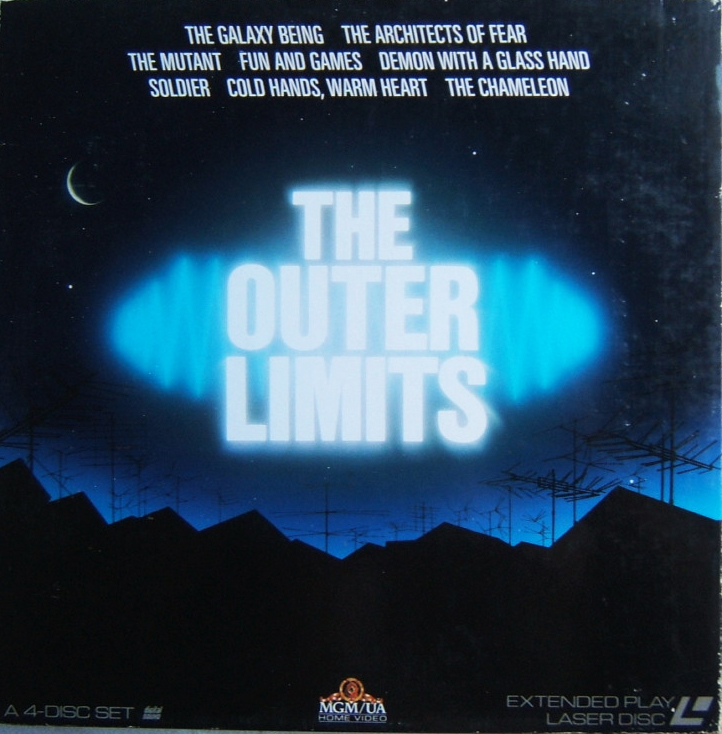
"The Galaxy Being" also appeared on LaserDisc in 1990 in the first of four collections. I never had a LaserDisc player, so I can't really comment. I imagine the episodes looked better than the VHS tapes, but not as good as the DVDs would look 12 years later.
The episode arrived on DVD with the rest of season one in 2002. This 6-disc DVD set was later split into two different volumes, then later combined with season two for a mega-omnibus-type set, but the actual discs in all three releases are identical. Unfortunately, they're double-sided discs, which is prone to failure (I had to replace the first disc in my season 2 set a while back).
I'd love to be mentioning a blu-ray release at this point, but the sad fact is that, as of right now, none has been announced (gee, way to miss the 50th anniversary, guys). The Twilight Zone didn't hit blu-ray until a year after it turned 50, so maybe there's hope. The Outer Limits is my #2 blu-ray holy grail (right after the 1948 supernatural romance Portrait of Jennie, which is my second-favorite film of all time after Alfred Hitchcock's Vertigo; wow, you're learning all kinds of things about me today, aren't you?).
TRADING
CARD CORNER
Many of The Outer Limits' monsters were featured in a trading card set from Topps in 1964, and "The Galaxy Being" is no exception; in fact, it's represented on the very first card in the 50-card series. The cards were notorious (or hilarious, depending on your point of view) for the text descriptors on the backs of the cards, which had virtually nothing to do with the actual episodes that the monsters came from. "The Galaxy Being" is probably the most accurate which, as you'll see in the pic below, ain't saying much.
Here's a pretty comprehensive rundown of the classic card series, which are worth quite a bit of money if you have mint specimens. For poor schmucks like me, Topps brought 'em back in a limited-edition run of 5000 sets in 1995 (I picked up a set of these reprints a few years back; they can found pretty cheap on eBay). I'll be posting my own personal scans of the cards as we go; however, if you're impatient and want to see 'em all in one giant chunk, go here (whoever did those scans jacked the contrast a bit too high, but they still look great).
Rittenhouse produced a set of 72 TOL cards in 2002, 9 of which depicted scenes from "The Galaxy Being." Now, despite my mixed feelings about the episode, I could easily find 9 compelling images to use... unfortunately, Rittenhouse couldn't.
Compared to the Topps cards, these are boring as hell (but yes, I have a set of these too; just the base set, mind you). Rittenhouse produced several autograph cards as well, including ones signed by Cliff Robertson and Jacqueline Scott. I've never attempted to collect any of them, but I'd love to snag the Robert Culp autograph card one of these days (I'll be talking a lot about Robert Culp in the weeks and months to come).
MERCHANDISE
SPOTLIGHT
The only Andy collectible I'm aware of is a model kit, sculpted by Chris Choin, from Dimensional Designs (the same folks responsible for the Behold, Eck! model depicted in this blog's masthead (and detailed here). $49.95 plus shipping and he/she/it can be yours.
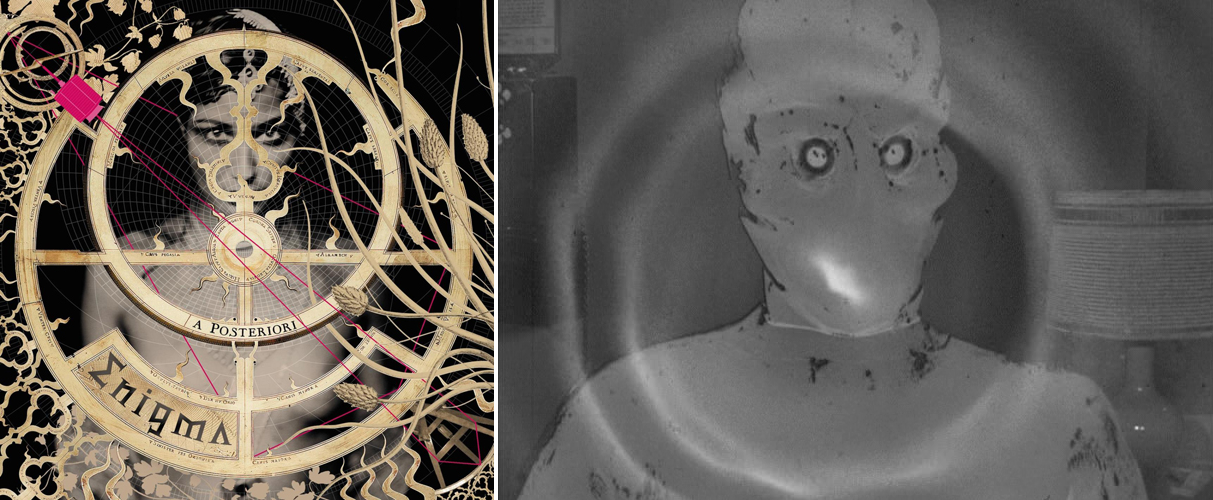
In the "so weird and esoteric there's no category for it" category, the cover of electronic musical artist Enigma's 2006 album A Posteriori strongly evokes this episode:
Coincidence? I dunno. I'll save the conspiracy theory stuff for next week.
THE WRAP-UP
"The Galaxy Being" is obviously not a favorite episode of mine; however, I can certainly appreciate it for what it accomplished: it sold the series to ABC, and it launched my second favorite TV series of all time. It's really not representative of the series, as it lacks the noirish, shadowy atmospheres and twisted psychologies that will characterize the majority of the first season; as such, it's far from the best the show has to offer, but it's certainly nowhere near the worst either. I'm not assigning specific ratings here, but I will say that, for me, it lies somewhere in the middle of the pack.






.png)


 The episode manages to reference several important sci-fi concepts, which is surprisingly given its light, airy ambitions. Squeezing time, if done without extreme precision, can result in the release of “negative matter,” an idea which would form the basis for Star Trek‘s warp drive propulsion (mixing matter and anti-matter to produce a controlled reaction). The ripple effect Phobos-One causes by altering a single seemingly-insignificant event has become a genre mainstay (particularly in Trek’s various iterations). There’s talk of “wearing out” a “sample area” of the space-time continuum by replaying an event too many times, an idea which I find endlessly fascinating (it’s as if reality is a carpet, which will become threadbare the more it’s walked on).


.JPG)

.png)

.png)

.jpg)

.png)


(1995).jpg)


.jpg)


.png)

.png)

.png)
.png)

.png)