“Second Chance”
Season 1, Episode 23
Originally aired 3/02/1964
Fifty years ago tonight, The Outer Limits went a bit cuckoo and presented a mediocre episode that, frankly, only a loon could love. Sorry, but this one's for the birds.
Dave Crowell is slumming as the captain of a flying saucer ride at Joyland Amusement Park, spending his free time casually flirting with Mara, the ride’s stewardess. What they don’t know is that, during the night while the park is closed, a bird-faced alien has been toiling to turn the ride into a fully-functioning, spaceworthy craft.
The alien has telepathically lured five individuals to the park: the irate and volatile Arjay Beasley and his long-suffering wife Susan, along with a trio of teenagers: All-American quarterback Buddy, his girlfriend Donise and his lackey mascot Tommy. The alien approaches each of them, pretending to be a park employee in costume, and gives them free tickets to the flying saucer ride. Despite varying levels of ambivalence, all five show up at the ride.
 The alien temporarily sedates Crowell and launches the ship into space. He explains that he is from the planet Empyria, a world that, in 82 years, will be struck by an Earth-like asteroid. Empyria will be forced out of its orbit and will eventually collide with Earth. The Empyrian has gathered these seven Earthlings in the hopes that they will help devise a way to avert the double catastrophe.
Crowell, who in reality is a disillusioned astrophysicist, agrees to help. The other Earthlings steadfastly refuse, however, clearly too absorbed in their own petty interpersonal conflicts. A struggle among the teens ends in tragedy when Tommy is accidentally sucked out through the airlock; later, Beasley resorts to attempted murder to convince the Empyrian to take them home.
 The Empyrian intercedes and laments the Earthlings' savagery and lack of cooperation. He explains that each of them was chosen because they, more than anyone else, needed a second chance, which this opportunity could give them. They still refuse to help, and the Empyrian agrees to return them to Earth. Crowell assures him that several scientists will eagerly volunteer to help, then shares a tender moment with Mara to simulate a happy ending.
RANDOMONIUM
 “Second Chance” began as an original teleplay by Sonya Roberts called “Joy Ride,” which was heavily rewritten by Lou Morheim (both received screen credit). Unhappy with the changes, she insisted that her pseudonym “Lin Dane” appear in the credits. The final episode suffers from its fractured authorship, much as earlier episodes like “ZZZZZ” and “The Children of Spider County” did. For every interesting character moment, there’s a corresponding sci-fi action cliché to undermine it. In his Outer Limits Companion, Schow places most of the blame on Morheim, providing copious examples and comparisons (which can be found here; scroll down to see the salient tear pages).
 My single favorite moment in the entire episode is when Crowley tells Beasley that it's all real, that they are in fact flying through outer space. Beasley, dumbstruck and dazed, asks "But why? Why is it real?" It's a moment of fearful, almost childlike wonder that, for a brief moment, humanizes the bitter and detestable Beasley. I'll assume I have Roberts (and not Morheim) to thank for that.
Paul Stanley occupies the director’s chair for the first of three tours of duty; he’ll also helm “The Guests” in a few weeks and “Counterweight” next season (the latter of which is actually quite similar to “Second Chance”; more on the similarities when we get to it in December). Director of Photography Kenneth Peach brings a more austere, workmanlike look to the proceedings than we’re used to (yes, I already miss Conrad Hall’s intense contrasts and canted angles), but given the limited sets (a merry-go-round, a Coke machine and the interior of the flying saucer) he does fine. Act three opens with a seriously trippy 360-degree shot of the unconscious abductees with random lights swirling around. And speaking of canted angles, we’re treated to a hilariously over-the-top pre-Star Trek flinging-back-and-forth sequence as the saucer passes through a meteor shower. I don’t know if we have Stanley or Peach to thank for this (or both), but a good laugh was quite welcome as I slogged through the episode.
*Sigh* So once again we have a goofy and circuitous alien plot, the failure of which results from the alien’s puzzling failure to simply ask for help (“The Mice”), coupled with mankind’s inherent penchant for assholery (take your pick of the episodes we've already seen; humanity is almost invariably portrayed in a negative light on this show… probably rightly so). The abduction of Earthlings --- even a smart guy like Crowell --- seems laughably pointless, considering the fact that Empyria is four centuries ahead of Earth in technological development (try to think of a task we could only accomplish with the help of early-1700’s scientists. Can’t think of one? Me neither). Of the seven (six after poor Tommy bites it) abductees, only Crowell could even hope to contribute anything of value (but again, I tend to doubt it). Beasley in particular is such a caustic dick that he could never be anything but a liability to the project.
 But really, all of the abductees are awful people with their respective heads shoved deep into their respective asses (except for Crowley and Mara, the Ross and Rachel of the group), and could never bring anything good to such a noble undertaking as saving two worlds. Donise is a shrieking basket case, Buddy is sullen prick, Tommy is a groveling suck-up, and Susan... well, I guess she isn't terribly offensive (her only real crime is staying with Beasley). I also have a hard time believing that these seven were chosen because they have “the least to lose” by abandoning their lives on Earth. Wait, these folks? Out of the entire human race? Really? Well, how about... I dunno, death row inmates?
The sight of Tommy’s corpse floating outside the airlock is certainly chilling, but the fact that the others --- particularly his fellow teenagers --- seem to forget about it almost immediately dissolves most of its impact. There also seems to be no meditation on just how his absence will be explained, once the others are returned to Earth. His parting shot reminds me of the title sequence from TV’s Buck Rogers in the 25th Century, which featured a cutout of Gil Gerard spinning in a circle.
So the Empyrian uses his goofy medallion to disintegrate people (the night watchman at the top of act one) and objects (Beasley’s pocket knife in act four); more interesting is his ability to render people unconscious with what appears to be some kind of telepathic sedative (the visual manifestation of which is a series of concentric circles emanating from his face; we saw this identical effect in “The Galaxy Being” when Andy the Andromedan torched his various victims). So he really doesn’t need the medallion most of the time, since he could in theory sedate his foes indefinitely. And really, if the Empyrians are peace lovers, they really shouldn’t be disintegrating people at all, especially a minimum-wage slob just doing his fucking job.
 The Outer Limits is often guilty of reusing props from other TV shows and films (last week’s “Specimen: Unknown” was practically drowning in leftovers from the 1959 CBS series Men into Space). For “Second Chance,” however, a brand new spacecraft was commissioned. Granted, it’s a fairly stereotypical flying saucer job, but it works in context (since it's masquerading as an amusement park ride). What’s really impressive is the full-scale set of the saucer’s interior. Two stories, baby!
As a lover of all things retro-futuristic (please bring back the original Tomorrowland, Disney!), I love the "vision screen" part of Joyland's Flying Saucer ride. We see some swell seen-'em-a-thousand-times stock shots of various space phenomena, accompanied by Don Gordon's soothing ruminations on the possibility of extraterrestrial life. Sublime.
“Second Chance” is something of a sci-fi take on Reginald Rose’s Twelve Angry Men (which is one of the plays I did in high school; I was Juror #7). Both feature a semi-random collection of people with varying neuroses (and varying levels of intolerance) trapped in close quarters, laboring under tensions that culminate in the threat of violence with a knife. Good thing the jury room didn't have an airlock.
The Empyrian’s bird-faced mask appeared again, rendered even more birdlike with the addition of a beak, in season two's "The Duplicate Man." It then resurfaced a couple of years later (with a different beak) in the original Star Trek pilot “The Cage” in 1966.
The act two scene in which Beasley angrily does battle with an uncooperative pop machine (with his poor wife trying futilely to diffuse him), is strongly reminiscent of a similar scene from “The Fever,” a first season Twilight Zone episode in which Everett Sloane tangles with a stingy slot machine.
The Empyrian clearly has some difficulties manipulating the controls of the saucer, what with his talons and such, but like the Chromoite before him, he gets the job done in spite of his sub-dexterous handicap. However, he has no trouble whatsoever getting handfuls of both ladies during act two (props and respect, Big Bird).
Other carnal delights include Janet De Gore’s glorious, unstoppable bosom and the above-described opening shot of act three, in which we’re treated to a floor-level pan across both ladies’ laps (while they’re unconscious, no less! Talk about a voyeur’s paradise!). I couldn't actually see up their skirts (though I tried; believe me, I tried), but it’s possible that DVD’s limited resolution simply isn’t sufficient to allow such wonders. MGM, if ever there was a reason to remaster the series in high definition….
AURAL PLEASURE
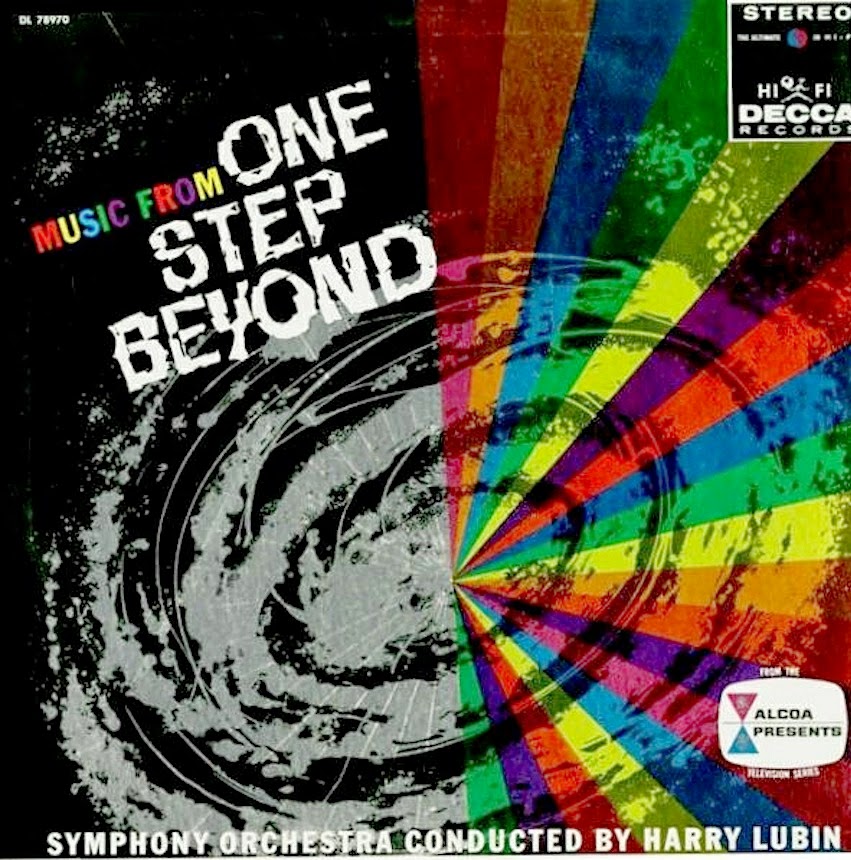
The music you hear in this episode is music you've heard before and, before the season is over, you'll most definitely hear again (and again, and again). That's right, kids, it's another stock-scored job in which you'll thrill to such timeless Dominic Frontiere tunes as:
Escape and Recapture, Transit Attempt, Chromoite Breaks In (“The Mice”)
I couldn’t place the music punctuating Beasley’s attempt to murder Crowell and their resulting struggle; I can only assume it came from Frontiere’s previous work on Stoney Burke. Speaking of which, our old friend the “Stoney Burke Mystery Cue” is back once again (at time stamp 11:11; see clip below). It appears twice more, at 19:12 and 23:30.
DRAMATIS PERSONAE
Don Gordon, who was marvelous in “The Invisibles” exactly one month ago, appears again here as Dave Crowell, Empyria’s Great White Interstellar Hope. Interestingly, he's billed as a "special guest star" this time around (wonder what changed during that month?). Gordon was also quite good in two Twilight Zones (“The Four of Us Are Dying” and “The Self-Improvement of Salvadore Ross”; the latter co-starred the lovely Gail Kobe, who appeared in last week’s “Specimen: Unknown.” He got to kiss her and everything, the lucky sumbitch). He also appeared in "The Trial," an episode of my newest sci-fi TV obsession, The Invaders (1967-69).
.png)
 Simon Oakland’s distinctive voice is unmistakable through his Empyrian costume, adding an extra layer of gravitas atop an already-standout performance. A year earlier, he appeared on Daystar’s pre-TOL series Stoney Burke (“Image of Glory,” which also guest-starred TOL alum Dabbs Greer). He also did a Twilight Zone (“The Thirty-Fathom Grave”), but y’all probably remember him as the psychiatrist who explains Norman Bates’ condition at the end of Alfred Hitchcock’s Psycho.
The detestable Arjay Beasley is brought to angry life by John McLiam, who did two stints on Stoney Burke (“Fred” and “Five by Eight by Eight,"). McLiam also visited The Twilight Zone a total of four times (“The Shelter,” “The Midnight Sun,” “Miniature,” and “Uncle Simon”; you won’t actually see him in that last one because his entire scene didn’t make the final cut). Oh, and he also popped up on The Invaders (“Storm”).
John McLiam (center), giving some fatherly advice to Bennye Gatteys (left),
We've got two TOL babes to drool over this week. First up is Janet De Gore, who plays space stewardess Mara Mathhews. Next we have Mimsy Farmer, who plays self-absorbed teen beauty Donise Ward (before you ask, Mimsy turned 18 before “Second Chance” went into production, so there’s nothing creepy about me checking her out). As far as I could tell, neither actress has any other series or genre connections.
HOME VIDEO RELEASES
“Second Chance” flitted onto VHS in two forms. First, there was the standard retail edition, sold in fine stores everywhere, which featured the customary awesome cover (love the screaming women in the background; but hey, MGM, why no headlining actor? Don Gordon's name was shown on "The Invisibles" box; strange that we don't see it here). Second, there was the mail-order exclusive Columbia House edition, which paired the episode with “The Children of Spider County” from two weeks ago (creating a double feature of wasted-potential mediocre offerings).

Meanwhile, the episode got no love on LaserDisc: a total of 28 TOL episodes were released on the (then) superior format, leaving 21 to a tape-only fate. Until 2002, that is, when MGM released all 32 first season episodes on the (relatively) new DVD format (season two followed in 2003). MGM would go on to re-release the DVDs two more times (in 2007 and 2008), but as of this writing hasn’t taken the next logical step and committed to a Blu-ray release. Therefore, MGM, I fart in your general direction… but I’ll happily give you a “Second Chance” if you rectify this oversight pronto (see what I did there?).

Ah, Hulu, that gleaming wonder of modern entertainment! You (or somebody like you) can watch The Outer Limits on Hulu’s website, which means those of you who don’t own the series on home video can now easily enjoy every single episode with a few mouse clicks. The best part? It’s 100% free! I know… crazy, right? However, bear in mind that this particular Life Hack has a frustrating limitation: you can only take advantage of it on a computer. Hulu Plus, which allows paying members to stream content to mobile devices and Blu-ray players, does NOT include The Outer Limits at this time. Dammit.
TRADING CARD CORNER
Topps allocated an impressive three cards to The Empyrian in their 1964 Monsters from Outer Limits cards (a mint set of which will cost you at least a few C-notes; the 1995 reprinted set, which I own, can be had for a few fins or so). Our fine-feathered friend is recast as a “mad genius” from outer space who uses his “mind stealer” device to collect thoughts from unsuspecting humans. His downfall comes when he accidentally gathers the thoughts of the mentally ill and flees in a confused state. Oh. My. God.
MERCHANDISE SPOTLIGHT
You crafty model-building types might be interested in the Empyrian 1/8-scale resin model kit from Dimensional Designs, sculpted by Chris Choin (DD/OL/EM-04). I couldn't track down any decent shots of a completed model, so we'll have to settle for the single tiny image I found (right). $49.95 plus shipping and you can have your very own bearded alien-bird creature. Flying saucer not included.
THE WRAP-UP
"Second Chance," like other similarly-mediocre offerings from this middle-of-the-season slump, is ultimately less than the sum of its parts. Is it awful? No. Simon Oakland's Empyrian is one of The Outer Limits' most noble --- if a bit misguided --- aliens, and we do get some tasty eye candy (the ladies, the saucer, plenty of blinking lights, etc.) to make the trip a bit less disappointing.




.png)

.png)


.jpg)




.jpg)

+2.JPG)


(1992).jpg)


.jpg)
.jpg)
.jpg)


